
Neighbourhood Gynaecology: How a South African Startup Is Building a New Model for Uterine Care.
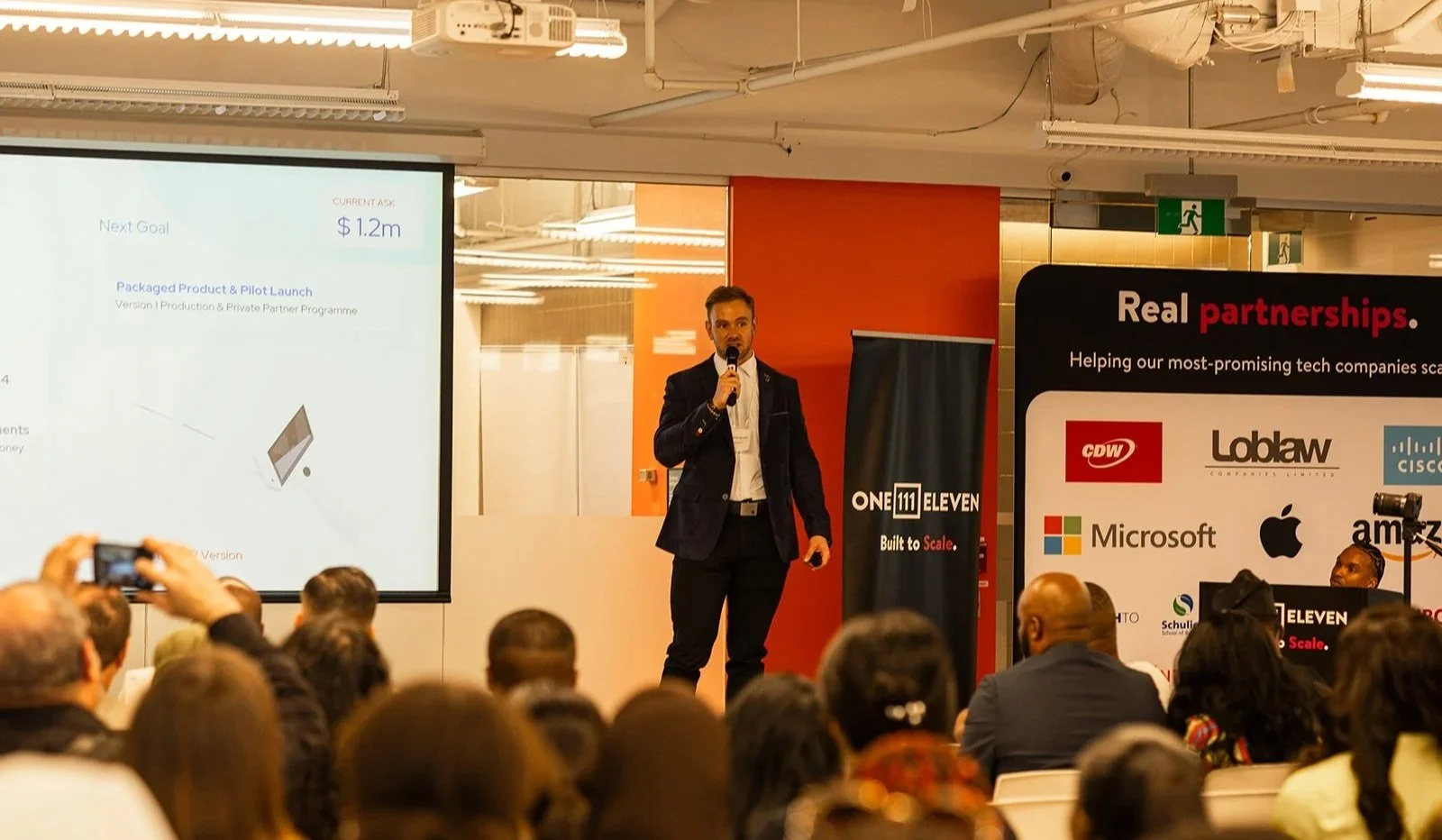
Chris K. Meunier presenting VAS Medtech at the Africa Impact Challenge Toronto Showcase, August 2024.
A founder story about purpose, patience, and building medtech products that matter from the African continent.
There are some problems so personal, so close to home, that you don't choose them, they choose you.
For Chris K Meunier, co-founder and CEO of VAS Medtech, the moment of clarity came not from a market report or a whiteboard session, but from a conversation that his co-founder Dr. Edmund Wessels had with the late Dr. Carol Thomas, one of South Africa's most prolific gynaecologists. Dr. Thomas had spent years travelling between rural clinics and urban hospitals, navigating both the public and private healthcare systems, and one of her greatest frustrations was always the same: she could not visualize the inside of a uterus at the point of care.
Women presenting with abnormal uterine bleeding, a condition that affects millions, were being sent home or referred onwards when, in many cases, a polyp or growth could have been identified and treated right there in the room. The human cost of that gap was enormous: weeks of anxiety for patients, delayed diagnoses, missed treatment windows, and a cycle of referrals that a stretched healthcare system could barely sustain. Dr. Thomas's insight eventually became the seed of Flexigyn, VAS Medtech's flagship hysteroscopy device. But before we get to the product, we need to understand the people.
An Unlikely Co-Founding Relationship.
Dr. Edmund Wessels chose women's healthcare as the subject of his PhD in biomedical engineering at the University of Cape Town. Chris K Meunier, meanwhile, was running Unscene; a brand and marketing agency working across Cape Town and London where his specialty was connecting purpose to product and commercialization. The two were friends first, and in that friendship, each saw what the other was quietly building on their own.
"I think if you get along as friends first, there are already complementary energies there," Chris reflects on how to build a co-founder relationship. "We were brought together by a common passion to do something with actual impact and a bit of a legacy attached to it."
What makes their partnership more than a good story is how precisely their skill sets map to the challenge of bringing a medical device to market. Chris draws on a framework he encountered during their journey: science discovers new things about the world; engineering makes those discoveries useful; design and communication help people actually adopt them. Edmund sits firmly in the engineering space. Chris sits in the adoption space. Together, they cover the full arc.
For aspiring founders looking for their own Edmund, or their own Chris, his advice is unambiguous: don't rush it, and don't compromise. "An arrow is only as effective as the sharpness of its tip. You should be driven to find other A-players." He goes further: treat the co-founder search like a fundraising pitch. People aren't just joining a startup, they're investing their livelihoods, their time, their energy. Pitch accordingly, and only say yes to someone who matches your tenacity and your skill gap.
Building Flexigyn: The Long Game of Medtech
What separates medtech from most other startup verticals is the sheer predictability of how hard it is. The regulatory pathway is not a surprise you encounter later, it is as Chris puts it, a design input from day one.
VAS Medtech's product, Flexigyn, is a compact hysteroscopy device designed to bring uterine visualization and treatment to primary healthcare settings, not just surgical theaters. This changes the game completely and improves access to care. The vision is accessible, affordable, point-of-care diagnosis and care for abnormal uterine bleeding. That vision demands navigating the FDA, SAHPRA (South Africa's regulatory body), device classification systems, quality management systems, clinical evidence packages, and usability trials, all before a single unit ships.
When they started, Chris and Edund were at TRL (Technology Readiness Level) 1. They are now at TRL 6 with a human factor study scheduled for the coming year that will push them to TRL 7 and, thereafter, toward FDA submission. The product they will submit is an alpha prototype they are currently industrializing into a manufacture-ready device, not just engineer-ready.
That journey from prototype to industrialization required $500,000 in funding modest by medtech standards, extraordinary in terms of what it produced: four prototypes, two usability trials, and a growing evidence pack that speaks to both regulators and investors.
"We prioritized whatever de-risked the next decision fastest and produced evidence we could reuse for regulatory and for fundraising," Chris explains. It's a deceptively simple insight that carries enormous practical weight. A 3D-printed prototype in the hands of a clinician even formally generates feedback, generates quotes, and generates momentum. That same session, during a formal human factors study, can become part of your regulatory documentation and your investor deck. Two birds, one stone.
The Funding Reality: Grant-First, Cap Table-Last
Raising capital in medtech from Africa is not a single challenge, it is a cascade of them.
The first lesson VAS Medtech learned was to front-load grant funding. Grants, unlike equity, don't dilute your cap table, and in medtech, where significant raises come later, protecting that table early is strategic survival. More importantly, grants are built for exactly the phase most medtech companies occupy at the start: scientifically novel, not yet commercially proven.
"Early on, you want to be rapidly prototyping," Chris says. "But there does come a stage where even just the regulatory submission, or hiring people to put together a quality management system, becomes very capital-intensive."
The $300k seed round they eventually raised came in response to a specific need: getting a landed, manufacturable product on the table. Not a concept. Not a CAD render. An actual device they could submit to the FDA.
But here's where the story gets interesting. While raising funds for the hardware, Chris and Edmund noticed that the funding environment had shifted. Investors who once accepted pre-revenue medtech companies were increasingly demanding revenue proof an almost impossible bar for a hardware medical device on a 7-10 year development timeline. Their response was to launch Digigyn, a complementary software platform that could reach the market faster, demonstrate real-world traction, and critically begin building something Africa urgently needs: a representative women's healthcare dataset for AI applications.
"It doesn't distract us from the core mandate," Chris explains. "It amplifies it."
Digigyn is not a pivot. It is an ecosystem expansion anchored to the same purpose: Neighbourhood Gynaecology. The same vision, a different instrument.
Taboo as a Barrier to Capital
One of the most candid parts of Chris's story concerns something that many founders in women's health quietly experience but rarely name publicly: investors who let personal discomfort with the subject matter translate into investment hesitation.
"People often conflate their own personal biases or their ideas of taboo as a riskier investment," he says. "When it comes to women's healthcare, reproductive health, sexual health, people have a knee-jerk reaction."
In early meetings, VAS Medtech leaned into clinical language; precise, technical, stripped of emotion, hoping it would neutralize the discomfort. It didn't work. What worked, eventually, was the opposite: leaning harder into the human story. Painting the picture of a world where Neighbourhood Gynaecology is as accessible as a pharmacy. Mothers with more time for their children. Women who can grow their careers without the shadow of an unresolved diagnosis. The texture of real lives, not the architecture of clinical trials.
"It's sometimes better to be more effective in your conversation than to bring up 20 statistics that are technically correct," Chris says.
This is not a rejection of data. It's an understanding that data needs a story to travel. The statistics matter. In South Africa alone, there are just 1,900 gynecologists for 19 million women of reproductive and post-menopausal age. Still, they land differently when they are attached to a face, a consequence, a life.
What Africa Gives You That Nowhere Else Can
There is a version of the VAS Medtech story that positions Africa as a constraint limited infrastructure, tough fundraising conditions, and thin regulatory ecosystems. Chris lives a different version.
The African healthcare context is precisely what makes the Flexigyn vision necessary, scalable, and globally relevant. The task shift already happening in the UK and parts of America where nurses and GPs are being certified to perform hysteroscopic procedures maps perfectly onto the African healthcare reality, where that shift isn't a policy experiment but a daily necessity. Building for the most constrained environment means building something robust enough for everywhere.
And then there is the data opportunity. AI-powered women's healthcare tools trained on Western datasets carry the biases of those datasets. The gap in representative African women's health data is not just a problem, it is a market. Digigyn positions VAS Medtech to be the company that starts filling it.
For the Founders Reading This
Chris closes with something that doesn't fit neatly into a product roadmap or an investor deck but matters more than almost anything else: the durability of the reason you started.
"Your brand purpose really does lock you in to a central product thesis," he says. The form of your product can change. Your path through the regulatory maze will definitely change. But if the purpose is clear, if it is specific enough to say no to the wrong opportunities and yes to the right ones, then the thousand small decisions that medtech demands of you every week have somewhere to anchor.
There will be days, he admits, when you are staring into the abyss with no clear sense of the next step. That's where the co-founder matters. That's where the community of fellow entrepreneurs matters, the kind forged in programs like the African Impact Initiative, where the common thread isn't geography or sector but the belief that the world can and should be better.
"The only thing necessary for evil to succeed is when good people do nothing," he says. "Entrepreneurs choose to do something. That's really what makes a difference."
VAS Medtech is not a company that happened to choose a hard problem. It is a company that was chosen by one and decided to answer.
VAS Medtech is a portfolio company of the African Impact Initiative. Learn more at vas-med-tech.comandafricanimpact.ca.